Showing posts with label Stickers. Show all posts

Sunday, August 4, 2013

Soccer 88 - Daily Mirror Sticker Album

Continuing my theme of writing about non-Panini sticker albums, I'm doing it again and this time it's a sequel. Having covered the Daily Mirror's first foray into football stickers with 1987's Stick With Soccer, what we have here is their follow up from 1988.

There are some noticeable changes from the 86/87 album and, perhaps sadly given how different that album had been from the usual Panini fayre, most of them seem to have been done to fall more in line with the accepted version of the sticker book format. What I'm saying is, they Paninified its ass!

The 2 most obvious changes come with the name. While "Stick With Soccer" had followed the numbering format to match the league season it related to (86/87), Soccer 88 adopted the traditional (i.e. Panini) approach of the year the book was released in.


Secondly, "Soccer 88" is now the actual title (as opposed to the last one being officially titled "Stick With Soccer - 1986/87 Season"). This one does however, have a nice subtitle - "Britain's Top Sticker Album". Note, there's no asterisk there linked to a footnote with something like "in the Gateshead area for 3 weeks in March", nope this was apparently Britain's top sticker album. One can only assume that to be true as it's highly unlikely a tabloid newspaper would print any outlandish claims without facts to back it up. And that, ladies and gentlemen, is satire.

There's also been a price reduction...from 25p to FREE!

some words
One thing that hasn't changed is the foreword, blandly presented again by Bryan Robson...pretty sure he didn't write it though the sheer moribundness of it all maybe suggests he did. I have a lovely image of him, chewed pencil in hand, tongue sticking out as he concentrates oh so hard to fulfill the 200 word brief.

The intro does reveal that in the 87/88 season the top flight was in one of those transition phases between 22 and 20 clubs...in other words, 21.
There's also 360 stickers in total, up from 286 the previous year (thanks Bryan).

Wot no Villa?
An extra little nugget from the inside cover shows that Daily Mirror stickers came not in packets, but in "envelopes" - 6 stickers (surprised they didn't call them sticky-pics or something) costing 12p...

As with 86/87, we dive straight into the teams (all 26 of them...I'll come to the other 5 later) and of course it's perennial sticker book openers, boring boring Arsenal. These are of course followed by...Charlton. Eh? Where are Aston Villa? This is 1988, they're in the 2nd Division...which is funny...much much funnier than being in the 3rd tier with no home and -10 points oh yes! (SISU OUT!).

Sansom and...is it midnight?
One other new feature where the Mirror have, er, been inspired by Panini, is the introduction of foil stickers. That doesn't mean we get club badges (copyright issues anyone?), but instead the foils are reserved for the Team Manager and the Captain. The foils are...how shall I put this...crap?

Where the Italian foils are lovely and magpie-temptingly shiny, the Mirror's are just...dark. Sure if you shine a bright light on them they just about display their wares, but they're hardly what you'd call a mirror finish (and there we have ourselves a whole plate of pun...a punnet even...I'm on FIRE!)

CCFC...because I can...
Also making its debut is the player profile shot. 86/87 was all action, but this time round there's a strange mix of almost all action and then the odd player's mug appears. It all adds to the rather cheap feel that dominated the previous album and somewhat lets down the clear attempt to be taken more seriously. They should have stuck with one or the other and given the quality of the photos in this album are much better than before, the unique angle provided by the action shots should have been used as a USP. Speaking of the stickers, the quality level may have increased, but the stickers themselves have shrunk...down to normal Panini size, therefore allowing for more per page (hence the increase in number).

Super indeed!
The middle pages detail a rather bloody good competition to win a 10 day holiday to watch Euro 88 in West Germany. No doubt funded by the Mirror newspaper group, this was nevertheless something you wouldn't have found in any Panini album. Naturally, this is advertised heavily on the front cov...no wait...there's no mention of it anywhere prominent. Another opportunity missed! Contrary to competitions these days, to win this you had to choose your England XI to win Euro 88. Wonder how many entries would have done better than the real 11.

Rangers? Rings a bell...
After the 21 English Division 1 clubs are covered, there's time for some north of the border action. And by some, I mean 3 teams. Aberdeen, Celtic and some team called Rangers? Nope, me neither...

The final pages are taken up with a quite-common-at-the-time World Stars selection, featuring the best of the football world at the time, from Josimar and Maradona to Sanchez and...er...Glenn Hysen and the ultimate England squad as chosen Sir Alf Ramsey. One can't really argue with his choices, although the choices do seem to be either 1966 or 1988...the 2 decades in between seem to have been skipped over. Keegan, Brooking? Nope, but we do have Alvin Martin...nah, I'm kidding...he's not there.

Class from home and abroad
And that's your lot. As with the previous album, Soccer 88 was to the point with little in the way of superfluousness, but in my opinion, it was better for it. Despite the obvious lean towards sticker album conformity, it's a clear level above its predecessor and one can't help but feel that if they'd made another, which I'm pretty sure they didn't, it would perhaps have been a decent rival to the great Panini. As it is, they ducked out of sticker albums and so these two serve as the Mirror's sole efforts from the 80s. Around this time, Merlin were just getting started and would go on to provide a serious rival to Panini with the introduction of the Premiership. Perhaps this newcomer finally convinced those at the Mirror that there just wasn't room for a third top flight sticker collection. I guess we'll never know...

Friday, May 17, 2013

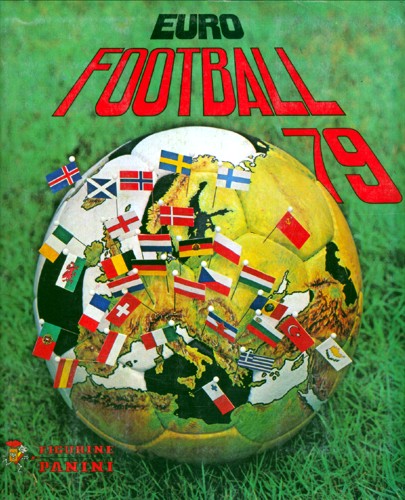
Panini: Euro Football 79

My failing memory doesn't recall Panini's Euro Football 79 being on sale in the UK when I was a kid. If that's the case, it's an almighty shame because this, for me, was one of the best Panini sticker collections ever made.

It's not just the variety and quality of the stickers inside the album that elevate it to such a celebrated plain, but the simplicity and logic of its structure. In basic terms, the album was split into three parts, one for each of the European club competitions that existed back then. Within each of those parts were five sub-sections containing a Roll of Honour, pictures from the previous season's Final, the fixtures for the upcoming season (1978/79), the teams involved in them and the players to look out for. Nothing more, nothing less... and it was all the better for it.

Sadly there were no shiny foil stickers in this collection, but there were special trophy stickers to obtain, and these belonged on each of the three Roll of Honour pages. Though the white background lacked that unique glittery pizazz seen in other collections, the trophy stickers were still a smart way of heading up the lists of the previous Finals.

The 'Trophy' pages

Looking at the 'European Cup' section, we're first treated to a three-page pictorial review of the 1977/78 Final at Wembley between Liverpool and Club Brugge. Here it seems Panini's designers really allowed themselves the indulgence of creating a mini photo album. Thirteen pictures showing The Reds' victorious night were there to be formed from one, two or four stickers in what must be the most ambitious attempt at creating a set-piece display Panini had ever made up to that point. And there was one of these photo journals for each of the three European Finals in the album.

European Cup Final 1977/78

European Cup-Winners' Cup
Winners, Anderlecht
Similarly, each of the three sections had a fixture chart that the young sticker collector could fill in whenever a round of matches was played. A simple layout featuring a four-part picture of the current holders at the top of the page ensured an attractive item that kids would return to time and again.

But if it was team pictures that the album's owner was really after, they weren't to be disappointed. A comprehensive selection of all the teams taking part in Europe's top competitions in 1978/79 provided a whole raft of images to collect, and again they were available as one-, two- or four-part pictures.


European Cup teams: Real Madrid, Rangers, et al.

And what wonderful pictures they are. The colours really come shining through and the players you find yourself spotting - some of them stars from the World Cup - provide a great deal of pleasure throughout.

European Cup-Winners' Cup teams: Ipswich, Barcelona et al.

Similarly we get ample opportunity to marvel at the wide range of competing teams from across Europe, many of whom were so obscure that you wouldn't have even heard of them as a pre-teen football fan back then. To actually discover teams from as far afield as Czechoslovakia, Luxembourg and Bulgaria was therefore a revelation and one not generally derived from Panini's domestic sticker collections.

UEFA Cup teams: Athletic Bilbao, Nantes et al.

Euro Football 79 also drilled down to player level too, and here we get to see pages with a more familiar look and feel. Head shots of 120 footballers across all three European competitions were featured throughout the album, and again a wide range of countries and clubs made the overall piece more interesting.

European Cup players

In the European Cup section, Liverpool feature prominently through four players (Emlyn Hughes, Kenny Dalglish, Ray Clemence and Graeme Souness) as do Juventus, but there are familiar faces on show throughout including Uli Stielike, Rene Van De Kerkhof and Nottingham Forest's Tony Woodcock.

European Cup-Winners' Cup players

The Cup-Winners' Cup section had more masters of Total Football in the shape of Anderlecht's Ron Rensenbrink and Arie Haan and Barcelona's Johan Neeskens. A pre-breakthrough Michel Platini could also be found along with the twin Ipswich talents of Mick Mills and Paul Mariner.

UEFA Cup players

As for the UEFA Cup, here's where we get the greatest combination of world stars and common Football League luminaries. Rubbing shoulders with Mario Kempes (Valencia), Paolo Rossi (Vicenza) and Ruud Krol (Ajax) you'll just as easily find Bob Latchford (Everton), Mick Channon (Man City) and Cyrille Regis (West Bromwich Albion). The UEFA Cup was surely a very strange battlefield back in 1978...

Frankly I could go on forever talking about the charm of this sticker album, but I won't - even though I haven't yet mentioned the delightful squiggly pen-and-ink illustrations on many of the pages. Instead I'll wrap up by saying that when this sticker album appears in complete form on eBay, you can expect to pay somewhere in the region of £100 for it, and rightly so in my opinion. As a snapshot of European football as it was back in the late-1970s, it's a real thing of beauty and certainly a joy forever.

Retro Round-Up - 17 May 2013

After the relentless parade of FA Cup articles we brought you last week on The Football Attic, this week's been a little quieter for us post-wise, but fortunately there are lots of other like-minded folk on the interweb that have been doing their bit for the football nostalgia cause. Here's a selection of the best we could find for your viewing pleasure.

Hull City's tumultuous promotion campaign this season prompts The Two Unfortunates to remember a similarly successful time for The Tigers back in 1965/66 - read about it here...

Double Diamond works wonders - even for under-age kids! (Well it does if the double diamond in question belongs to Umbro, according to Got, Not Got...)

The Goldstone Wrap takes a look back to the seemingly random coming together of Brighton & Hove Albion and Nigeria in a friendly match in 1981...

Billie Jean-King playing for Swedish women's football team IFK Hässleholm? She could be in the front row of a picture at The Vintage Football Club, but it's probably not her...

On Goals Scored have a nice infographic showing how many times various teams have changed manager since 1985...

And for anyone that wants an instant classic sticker collection, what about this set of 37 albums in a single eBay lot? Yours for only £1,350...

Friday, December 28, 2012

Panini: Football 80

I’m a big fan of the ‘white album’. Some say it epitomised the peak of popular culture around the time of its release but I have a more balanced point of view. For me, It was experimental in certain areas but also rested heavily on its obvious strengths to provide a combination that’s rarely been bettered. Perhaps we’ll talk about The Beatles later, but for now, let’s stick with Panini.

Football 80 was their third domestic sticker album for the UK and was the first one I ever owned. It had many familiar aspects retained from previous collections, but you could sense a notable intent to try out the occasional new idea and tweak a few things here and there too.


Take the stickers, for instance. Compared to Football 79, they were squarer in shape once again and had a simpler design. Now, below the main picture, there was only the player’s details and a triangular pennant framing the club badge.

Speaking of badges, the silky, silvery fabric that had been so innovative the year before had been replaced for this edition by the now traditional shiny foil. It was a shame in many ways, but fabric was never really going to be able to convey the special status of silver on those wonderful club badge stickers.

As far as the album was concerned, the opening page was allocated to England manager Ron Greenwood’s introduction where he discussed his hopes for the coming season. England were on the verge of qualifying for the 1980 European Championships, and Greenwood reflected on the achievement of getting the national team to its first major tournament in ten years. An interesting way to get the album off and running, but an altogether more sober approach than the sticker-based map of the UK we’d had the previous year.

On the team pages, however, it was business as usual with every First Division team enjoying a two-page spread containing 17 stickers and among the sights to see were Brighton and Hove Albion appearing in Division One for the first time. Alan Mullery had taken over from Clough and Taylor at the Goldstone Ground and moulded together a squad featuring such luminaries as Mark Lawrenson and Brian Horton. They’d finish a commendable 16th out of 22 in the 1979-80 season that followed and would become something of a fixture in the top flight during the following seasons.

Then there was Coventry City who, with their six moustaches and two beards, were the hairiest of all the First Division teams featured in the album. Granted, Les Sealey’s beard was still a work in progress and Mick Ferguson probably had more hair than the rest of the team put together, but nonetheless this was a terrific display of hirsuteness.

A change of tack was applied for the Second Division pages. Previously, Panini collectors would have been looking to get the team picture and team badge for each of the twenty-two clubs, but for Football 80 it was possible to collect pictures for 11 players, plus the manager. Admittedly they all appeared in pairs on each sticker, but this was an excellent opportunity to get to know some of the players plying their trade outside the English top flight - especially in conjunction with the page of Second Division badges that preceded them in the album.

It could be said that Division Two was a land of sleeping giants. There was Birmingham City, led by Jim Smith and full of great players like Archie Gemmill, Alan Curbishley and Keith Bertschin. Chelsea, managed by Geoff Hurst, were trying to get back to the First Division with the likes of Ron Harris, Micky Droy and Clive Walker. Luton Town were on the rise with eye-catching talent such as Ricky Hill, Mal Donaghy and Brian Stein while FA Cup holders West Ham still had an eclectic mix of youth and experience managed by John Lyall - and that’s without mentioning teams like Newcastle United, Watford, QPR and Sunderland.

Anyone suggesting Division Two was equally as good as the Scottish Premier Division might have had a case, judging by the Football 80 album. That’s because for the first time, Panini had reduced the space allocated to each team from two pages to just half a page. To do this, they adopted the same approach as for the Second Division teams, i.e. putting a pair of players on each sticker and have all the badges on one page.

Almost certainly it wouldn’t have gone down well with fans north of the border, but luckily we weren’t to be totally denied the sight of a tracksuited Alec Ferguson, the Bukta sponsored Hibernian team or the reassuringly Dad-like Jimmy Bone of St. Mirren.

With a full-colour picture of the ‘Football League Official Ball’ on the back cover, this was the 66-page Panini album for the 1979-80 season. Unlike other albums, it lacked the occasional set-piece flash of brilliance but it made up for it with a consistently high standard from beginning to end. A good collection and one worth owning if occasional eBay purchases are your thing.

See also:

Wednesday, September 26, 2012

Panini: Espana 82

Of all the Panini World Cup albums, this one will always have a special place in my heart because it was the first one I ever collected as a child. Chances are I got my album as a free giveaway with Shoot! magazine (so many Panini albums were back then), after which the lure of the accompanying green sticker packets became too much for me to bear. So what was Panini’s Espana 82 sticker album like?

Front cover

It was often thought that nothing could beat the image of a football player on the front of a book or magazine to truly encapsulate the exciting nature of the thing. That was certainly the case here and an artist was commissioned to paint just such a player, but to ensure neutrality the he was shown wearing a kit of yellow and red because, let’s face it, no-one in their right mind plays in yellow and red.

Dribbling across the mainland of host nation Spain like a giant, it’s pleasing to observe the English flag featuring among those of all the participating nations rather than the flag of Great Britain which was so often used in lazy fashion by graphic designers for years and years. Aside from the multitude of national identities, the logo and mascot of the 1982 World Cup flanked the left margin below the album’s title, proudly displayed in white on that vivid pine green background.


Page 2 and 3

Turn the front cover and the first thing you see is not the list of world nations translated into six languages or even the page of foils showing the trophy, mascot, logo and poster. Instead, you’re immediately distracted by an insert promoting a competition where you could win a wide range of sporting equipment from Lillywhites. All you had to do was predict the best four teams in the tournament, and a quick glance at my album shows I actually filled in my application form without entering it. Sadly my guesses of Argentina, Brazil, England and West Germany wasn’t ever going to win me anything, so it’s just as well I didn’t waste money on a stamp with that one.

Stadia and Posters

Previous Panini sticker books for major competitions often featured stickers showing the cities where games were being played, but Espana 82 focused squarely on the stadia and provided artistic relief by showcasing the posters commissioned to represent each location. In many ways, these posters were the high point of the album and it’s only a shame we couldn’t get a better view of them on the rather small stickers.

As it is, the posters were beautifully designed by a wide range of artists and each one had a distinctive look that undoubtedly added something to the album if not the competition as a whole. One of the posters has since taken on a special significance for me as in 2007 I visited the museum in Bilbao dedicated to the work of Eduardo Chillida, the Basque sculptor and artist. Having spent the day wandering around the beautiful gardens where much of of his work was on show, I visited the gift shop on my way out and there hanging on the wall was the poster I remembered from my Panini Espana 82 album - Chillida’s design representing Bilbao in the World Cup that year.

Team pages

In common with many of Panini’s early albums (domestic and international), Espana 82 used a two-tier system which seemed a little prejudiced towards those teams seen to be making up the numbers. For the footballing heavyweights of World Cup '82, a two-page spread was provided across which 13 player stickers could be seen accompanying a team picture and silver foil badge. Sadly Panini felt at the time that some teams, such as Cameroon and Kuwait, were only worthy of a single page onto which were crammed 16 players on eight half-and-half stickers (plus badge and team pic). All a little unsatisfactory, but it does at least provide a different page layout for those wanting more variety.

As ever, a welter of useful and occasionally superfluous data was provided on each of the teams including recent match results, player birthdates and places, but if anything it was the player stickers that themselves blurred the distinction between good and not-so-good. Having gone into production well before the tournament started, it must have been the devils own job to include players that would eventually take part in Spain that summer and predictably some failed to materialise (Alvin Martin, I’m looking at you).

For those that were correctly included in the album, much confusion was caused in many a juvenile mind by the number of unfamiliar team shirts displayed on stickers (let alone tracksuits) because kit manufacturers, of course, used the World Cup to launch new kits. This, though, was the price we were willing to pay back then as, if nothing else, we got to see what sort of shirts a team was wearing before the World Cup began.

Back cover

To round off this decent, if unspectacular sticker collection, we were treated to an advert giving Panini collectors the chance to snap up a surely irresistible bit of footy kit. Yes, by sending off a cheque or postal order for £5.99, you too could own a Subbuteo holdall and a Kikari Soccer Trainer!

(What’s that? You don’t know what a Kikari Soccer Trainer is? Oh alright, if you must know, it’s a net that fits round a football on the end of a long piece of elastic so you don’t have to keep chasing after it all day every time you re-enact Terry McDermott hitting a 30-yard-volley. Satisfied now?)

Friday, August 10, 2012

The Football Attic Podcast - Episode 1


There's a well known philosophical debate that asks "If a tree falls down in a forest and there's no-one around to hear it, does it make a sound?"

Well, we can't answer that, but we can pose the question "If 2 blokes spend 40 minutes talking about Panini and stuff, will anyone listen?"

Thinking about it, it's more you who can answer that question... so... you know... download it... now!

Right-click and 'Save As' from the link below:

Football Attic Podcast Episode 1

or download it from iTunes... when I figure that out...

And please let us know what you think :)

Tuesday, August 7, 2012

Panini: Football 79

Having cracked the UK market the previous year, Figurine Panini returned with a new sticker collection – Football 79 – to further establish itself as the leader in its field.

The album's royal blue cover featured an action shot of Liverpool playing Club Brugge in the 1978 European Cup Final, but rather cleverly the designers also added a few well chosen stickers to make the collection even more appealing to young kids.

Inside once again was the trusty fixture grid into which scores could be written, but that was small fry compared to the first main feature of the album – a 6-part map showing the locations of all the league teams of England, Scotland and Wales. The map proved so popular that it returned the following year in Panini's Europa 80 album.

The stickers of the Football 79 collection were more rectangular compared to Football 78, but once again there were 17 of them for each team – 15 players, plus a badge and a team picture on every double page spread. The player stickers had a less cluttered look than before with each player name displayed simply at the bottom while a small pictogram featured just above it to indicate the team name, colours and badge.

The main talking point for Football 79, however, wasn't the player stickers but the team badges. For the first and so far only time in Panini's rich history of sticker production in the UK, team badge stickers were made from fabric rather than metallic foil. The fabric itself had a silky texture and a silvery sheen which was a masterstroke of design and added a tactile element to an otherwise papery norm.

Quite why these silky silver badges never returned in subsequent years is unclear, but one can only assume Panini (and the collectors of its stickers) favoured the shiny foils in far greater numbers. A shame as this was an example of great originality on the part of the Italian manufacturer.

The page layouts were much neater for this second domestic collection and a preference for showing the player biographies below the stickers was established in this album. Sticker spaces were decorated on either side by a column of red globe symbols while the text (including the team profiles) appeared in blue. For the Scottish League Premier Division, all the teams were given equal prominence at last although the club badges featured a green background rather than the silver one favoured by their English counterparts.

For the English Second Division, the same format was used as for Football 78. Each club had a badge and team picture – both in landscape aspect this time – with the badges sporting a gold background and a football symbol to the right of each one. The usual array of facts and figures for each team was on show, printed in blue throughout and accompanied again by a fixture grid.

Among the inevitable array of curiosities found within the Football 79 album are a youthful looking Sam Allardyce sporting the sort of moustache that no 25-year-old should ever have, Chelsea's Clive Walker sporting the frizzy blond hair and black beard combo that no-one should ever have and QPR goalkeeper Phil Parkes sporting the shaggy dog look that frankly no shaggy dog should ever have. All that, and the first sight of shirt sponsorship courtesy of Hibernian's affiliation with Bukta. Something for everyone, then, in this excellent Panini sticker album.

Thursday, June 14, 2012

Panini Euro 2012: How was it for you?

Two months on from our previous post, it’s now possible to assess the impact and effect of Panini’s Euro 2012 sticker collection. What have we learned from this self-adhesive sensation? Has it been a stick-on success or a double dose of despair?

Speaking from personal experience, there’s absolutely no doubt that Panini are enjoying something of a renaissance at the moment. For anyone thinking the days of sticker collecting ended when we outgrew our school uniforms, be in no doubt – Panini reigns once again, and age is no longer an issue.

As a 40-year-old blogger, I’ve been heartened beyond belief at the sight of so many peers devoting themselves to the pastime of tearing open packets and filling albums. A wide range of ages are covered, and though they’re located across all four corners of London and beyond, every man jack of them has taken the opportunity to exchange doubles and discuss their collections whenever possible.

The use of Twitter has undoubtedly been a useful tool in helping people to complete their Euro 2012 collections. And why not – back in our childhood days, we merely had to stroll into the school playground with a wad of swaps held together tightly by an elastic band in order to meet up with other like-minded souls. Decades on, the ability to tap into such a readily available group of fellow swapees is not so easy. Why not, therefore, use Twitter as a way to reach out to today’s Panini apostles?

Aside from the pleasure of swapping stickers with someone you barely know, the subsequent postal exchange of doubles is an ironic conclusion to any Twitter-based transaction. Social media tools can be said to have made communication easy as pie these days, yet at the end of it all we still have to rely upon the trusty old Royal Mail to receive the doubles we’ve requested. And let it be noted: there’s still something of a minor thrill to be had from hearing the plop of an envelope fall through the letterbox when you know there are stickers inside.

Being a London-based blogger, I’ve been lucky enough to meet many other people of the same persuasion to initiate an old-fashioned face-to-face swapping session. When I met Chris Nee from The Stiles Council several weeks ago, we found ourselves sitting in a darkened corner of the Sports Bar & Grill, Farringdon, staring intently at our open Panini albums on the table. It felt odd – embarrassing even at first: two men old enough to know better thumbing through each other’s packs of swaps, half-drained pints of beer readily within reach to one side. After a while though, that awkward feeling had disappeared. We were innocently enjoying that Proustian rush, harming no-one and living for the moment. Perhaps we were kids again, just for a short while…

A couple of weeks later, I met up with a whole crowd of bloggers in The Mulberry Bush on the South Bank. When I arrived, an entire corner of the pub had been taken over by people I’d known and respected for a long time like the written output they produce. Ryan Keaney, Jamie Cutteridge and many more were there, all heavily engrossed in the important business of assessing the swaps of others and filling their own albums. It was an extraordinary sight, but one which gladdened the heart. Panini stickers clearly meant a lot to a great many people, all of whom were happily using their hobby to hang on to a small part of their childhood.

Personally speaking, I was in the fortunate position of being able to display my list of ‘needs’ and ‘swaps’ here on the Football Attic blog site. This meant that I, like my co-blogger Rich, received a steady stream of emails from people wishing to exchange their doubles, and very useful they were too. It undoubtedly saved us both a lot of money in helping us reach that momentous point where we could apply for those last remaining stickers from Panini.

Interestingly, many friends of ours used similar tools to do the same. Some, like Damon Threadgold also posted lists on their blogs while others such as Terry Duffelen, Andrew Gibney and Ian Rands shared out Google Spreadsheets to the same effect. Either way, the internet was there to help us all – a technological playground we could all congregate in.

And what about the collection itself? Was it satisfying to undertake or disappointing? Well let’s get my personal conspiracy theories out of the way first. For my money, I accumulated an enormous amount of swaps early on – far more than with equivalent collections in years gone by. It was also a long time before I saw any England stickers to the point where one Twitter correspondent suggested they’d been mainly distributed in the north of the country. Probably not factually correct, but definitely the sort of thing that makes you wonder if it’s true or not.

I also saw precious few silver foils during my collecting campaign. When I visited the Panini website last week to order my remaining 33 stickers, the Germany badge, Ireland badge, Sweden badge and the bottom half of the tournament logo were all there among them, and that’s just four I can mention off the top of my head. There were plenty more where that came from.

Then there were the multipacks which, I’m convinced, provided a better selection of stickers than those sold from boxes. In the fullness of time, I came to see more ‘special’ stickers (i.e. badges, team pictures, slogans and so on) from the multipacks than I did from boxed packets. Coincidence? Who can tell…

As for the four-part team pictures, they were an ambitious feature on the part of Panini, but in execution not a huge success. Often was the time I found myself trying to marry up the matching details on adjoining stickers but I had the devil’s own job trying to form a decent looking whole. Somehow the printing and cutting of said stickers had gone awry in the production process and one can only hope they’ll sort that out before the 2014 World Cup collection comes out.

No matter, though. When I stuck the last of my remaining stickers in last night, it felt as though a genuinely fulfilling project had come to an end. The album was full and now it was time to reflect on a job well done. Yes, it had cost me a fair bit of money, but sometimes you have to spend a little to gain something exceptional. Panini’s Euro 2012 wasn’t just about collecting stickers – it was about sharing the experience with friends and feeling ever so slightly younger again, and that you cannot put a price on.

Tuesday, June 5, 2012

Panini: Euro 84

Given that England hadn't qualified for Euro '84, it was perhaps no surprise that I don't remember seeing Panini's sticker collection of the same name in the shops at the time. One thing I know for certain is that the BBC and ITV virtually ignored the tournament, the former showing a Spain v West Germany group game and the Final while ITV dropped their planned coverage altogether.

For those lucky fans with access to Panini's latest offering, it seemed that most things had remained the same since the Europa 80 collection four years earlier, but there were some minor changes to note for the eagle-eyed.

Front cover

No photographic image to catch the eye of a potential buyer on this occasion – instead, an artistic composition of a goalkeeper diving to the left on a blue background with the Eiffel Tower in the background and some gold bar lettering.

There's also a small cameo appearance from the tournament mascot, Peno the Rooster, plus the recently introduced UEFA 'Euro' logo in the blue and white of France.

Opening pages

As in 1980. the inside cover offered up all the qualifying round statistics and a chart to translate country names into six different languages – very handy for an international product such as this. Page three repeated the front cover design minus the goalkeeper with the bold and somewhat overworked 'Euro 84' lettering now in red. There was space for two stickers; one depicting Peno, the other being a gold foil showing off the Euro 84 logo.

Another returning feature and one retained in this year's Euro 2012 album was the Roll of Honour. This comprised of six stickers, each showing a black and white image of the previous winners, plus all the results from each of the tournaments between 1960 and 1980.

The following page was all about the posters for each of the eight competition venues. This was a new feature and one which showed how graphic design was being used to add a sense of identity to each of the Euro '84 venues. Many had a similar, modern feel – action shots of players heading, kicking or saving the ball – however the ninth poster, that of the Final, looked more like something culled from a 1950's French Ministry for Tourism office.

After that was the familiar site of a two-page spread showing pictures of all the stadia and the cities they were located in. Most striking of all was the view of Marseille harbour and all its boats and Strasbourg with its cathedral in the foreground. Sadly the view of St.Etienne's Geoffroy-Guichard stadium paled by comparison. Its pitch appeared to be covered in snow while nearest to camera five men can be seen sweeping up rubbish from the previous match.

Team Pages

Unlike the previous Panini Euro album, there was no favouritism shown towards the bigger teams. All competing nations had 20 sticker spaces for their players (and the coach) laid out over three pages coloured vividly in blue, white and red. Preceding them all was the traditional foil badge (all foils being gold in this series). There was also a four-piece team picture, doubled in size from those seen in Panini's Europa 80 album.

Everything else had a familiar ring to it – the spaces where you could fill in the results for each team, all the results per team since the last Euro competition and the 'Balance' table showing the total number of wins, draws and losses against all other teams.

As for the player stickers themselves, they had a clean appearance which looked a little more up-to-date than those in the previous Euro album. The tournament logo was inset into the top left corner, the mascot accompanied the player's national flag in the opposite corner and the player's name was at the bottom where you expected it. Nice, simple and easy to read.

Strangely in this album, there weren't too many opportunities for the reader to stop and giggle at a dubious player picture. If forced to pick out one, however, it would have to be the one featuring Klaus Berggreen of Denmark  who had the look of a man recently signed up by the Danish version of the FBI. Berggreen scored one of Denmark's five goals against Yugoslavia during the tournament but got himself sent off in the semi-final against Spain.

Excluded nations

Finally, at the back of the album, came the return of the Excluded Nations section – a chance for Panini to (a) bulk up an otherwise thin sticker album, and (b) remind you of the countries that were so good, they didn't see the need to win their qualifying group.

Over three pages, collectors had the chance to find a foil badge and both parts of a team picture for nine countries that failed to make the trip to France. England, of course, was one, but so too were the world champions Italy (who finished fourth in their qualifying group), the Netherlands (edged out by Spain), Scotland (edged out by everyone in their group) and the Soviet Union (second only to Portugal in Group 2).

The back cover

A map of France painted in blue, white and red showing the locations of each of the venues. On the off chance that words and place names weren't your strong point, the venues were also indicated by a sizeable picture of Peno in each case.