Showing posts with label Football Grounds. Show all posts

Wednesday, January 2, 2013

Things That Dreams Are Made Of - Arena 2000

At some point in history, Coventry City used to be in the promised land that is The Premiership. Towards the end of the 1990s, the last decade they occupied their perennial 17th place, several clubs faced with the changes brought about by the Taylor Report decided that, rather than redevelop their existing, often land-locked grounds, they would instead move to a purpose built stadium, usually out of town.

Derby County, Middlesbrough, Sunderland and Bolton, to name but a few, had all made the move, abandoning their outdated yet characterful grounds and, riding on the crest of the still fresh Premiership, had seen attendances rise and the money roll in.

Despite having already upgraded Highfield Road in the early- to mid-90s, the ground was plagued with the same problems as many other "traditional" stadia, being both hemmed in by housing, lacking any decent conference facilities and boasting few food outlets. And so it was that the plan to jump on the 'new stadium' bandwagon was announced.


This plan coincided with England's bid to host the 2006 World Cup and with Coventry selected as a potential host city (pending new stadium of course), it looked like the dream ticket!

It could have been so...slidey...
Arena 2000 was to be a 40,000 capacity super-stadium with innovations by the hatful. Information soon proliferated the press and talk of a sliding roof was mentioned and later a sliding pitch, putting us up with the latest in ground technology as seen at Ajax and Arnhem.

Around this time, I found myself wandering round the Sky Blues shop in town and spied a new publication. Being obsessed with football grounds, my eyes were immediately alerted by the image of a glowing architect's model of the proposed new Coventry stadium.

That publication was "a2", subtitled, "the official magazine of arena 2000 - the national arena in the heart of England".

Interestingly, it's marked as "Issue 1 Autumn/Winter 1999", though I'm pretty sure an Issue 2 was never forthcoming.

It's all about the tiles...
The 'magazine' is basically a glossy, 54 page brochure, showcasing all that never came to pass and covering in great detail all the great ideas that ultimately had disappeared by the time the Ricoh Arena finally opened for business six years later. The only things that did make it were the sky blue seats and some rather lovely tiles... although the tiles only ended up as part of hero walls where fans could pay to have their name and a message inscribed forever. That said, in the six years since construction, some of them are looking a little ropey and the messages not always very visible.

The magazine starts with an introduction from then chairman, Bryan Richardson, himself pictured with a large model of Arena 2000 and his final words sadly not in any way accurate... "The dream is now a reality".

It's curtains for a2...sorry
It's then straight into what everyone wants to know when looking at a new ground... the curtains! OK, that's slightly misleading... the curtains in questions being, rather than part of the soft furnishing choices of the Arena, 'giant roller blinds' that would be used to screen off sections of the seating areas during concerts. Rather than being merely a decorative item, these 'bespoke items' would also reflect sound back into the arena, ensuring no sound would be lost during concerts... when obviously the roof would have been closed...

A 'model' stadium
With the curtains dealt with, it's time to cover the architect's model and looking at the arena in physical form really does bring home what a fantastic place it would have been.

Moving on, Bryan Richardson is here again to espouse the hopes and dreams in 'The Vision', which, aside from covering the why's, also deals with the hows and moreover the wheres as one of the few things that didn't change, the location being the old foleshill gasworks, is shown. The gasworks is later shown in various stages of demolition.

An article on stadium naming rights, detailing the commercial necessity of such things, sits in close proximity to a 2-page advert for Jaguar again proving to be a rather sad foreshadowing of what was to come as for a long time, the Ricoh was due to be called the Jaguar Arena, before the car manufacturer decided to put their money elsewhere - probably wisely.

A final shout is given to the 2006 World Cup bid, showing a letter from the bid director Alec McGivan, where he states he'll be following the progress of Arena 2000 with interest.

So what happened to Arena 2000? Well, firstly, Coventry got relegated in 2001 and suddenly, spending a fortune on a 40,000 capacity stadium didn't seem like such a good idea. Then, Germany were given the 2006 World Cup (but at least that was really badly organised eh?  Oh...) and the last chance of a serious wodge of cash to spend on the stadium disappeared. The plans were scaled back, Ricoh arrived as last minute stadium sponsors and attendances ultimately plummeted as Coventry struggled to acclimatise to their new surroundings in Division 1, despite a 3-0 opening day victory. To this day, the only time the place has been full for a CCFC match was in the quarter final of the FA Cup against Chelsea - a match where the London side took the spoils.

A good start at the Ricoh

Given the current furore over the ownership and rental agreements of the Ricoh Arena, it's somewhat sad to see the potential that never was realised, the compromise, identikit ground we finally ended up with and the cold reality that replaced the fantastical hopes and aspirations.

Truly, the things that nightmares are made of.

Saturday, August 11, 2012

The Football Grounds of Europe

Most people have a list of things they'd save in the event of a fire. I have three books on my list (which kind of suggests it's a long list...I mean, I have a cat and three kids, but then again, the kids aren't on the list, they're old enough to save themselves... and doing the maths, that means each child can carry one of the books! Result!). Anyway, the books...the first of these is 'Mexico 86 - A Pictorial Review' by Phil Soar and John Bone, a glorious hardback book covering the whole of that tournament in great detail. The 2nd is 'True Colours' by John Devlin and the third is the subject of this article.

Have you ever wondered what various football grounds around Europe looked like towards the end of the 1980s?  Hasn't everyone?  Luckily for you, the great Simon Inglis has this covered with the excellent Football Grounds of Europe, published just before the 1990 World Cup which, may I remind you, was 22 (twenty-two) years ago!


As I have already confessed, I have an obsession with football stadiums (Stadia? Apparently both are acceptable) and as mentioned in that review, it's fascinating to see how much has changed in the intervening years. For example, 22 years ago, the Stadio Delle Alpi didn't exist, whereas now... oh right... bad example.

The Delle Apli Roof...sadly, no longer with us
The book starts with a brief introduction, before covering in depth, the stadia that were to be used for Italia 90. As it was written whilst most of these were mid (re)construction, it's somewhat a shame none of the pictures are of the completed venues, though given the ease with which one could find such info on the internet, it's perhaps a blessing that we instead get to see them before they became what they are today (or in the case of the Delle Alpi, what they were up until a few years ago). One point of note in the intro is FIFA's criteria for World Cup stadia - a minimum capacity of 80,000 (3/4 covered) for the opening and final games and at least 40,000 with the main stand covered for all other matches. I purchased this book in October 1994 which meant the World Cup had just been staged in the US where the rules about covered seating seem to have been put aside.

Stadium Porn...
On to the stadiums and up first is the stadium that started my obsession, the Stadio Giuseppe Meazza - more commonly known as Milan's San Siro. This beast of a place, the ultimate in brutalist and modernist architecture, the Lloyds building of football stadia first captured my attention during the opening match of the 1990 World Cup. Just home from school on that friday, ITV's fantastic opening titles, 'Tutti Al Mondo' (suck it, Pavarotti!) make way for my first ever glimpse of this marvel. Gigantic red beams suspending a massive roof over a sheer maze of lines, it remains to this day, in one's humble opinion, one of the most striking sights, not only in modern stadium design but in architecture as a whole.

As previously mentioned, as it was under construction at the time, there are no pictures of the completed roof, however that does mean we are treated to a view from inside the ground, several beams in place, but with a long way to go; the giant yellow cranes, later sold to a Japanese shipbuilder, looming over the extended third tier.

Brutal Beauty in the making

As with every stadium covered in detail in the book, the ground is given a comprehensive history and in the case of the 1990 World Cup venues, a lot of detail is presented on the trials and tribulations that went into their construction / redevelopment. The Luigi Ferraris stadium in Genoa (another of my favourites) seems to have gone through its fair share of hassle, ranging from over-reflective security screens that blinded spectators to having to purchase extra buildings in order to be able to build a second tier on one side.

A stadium of two halves...sorry...
I do think the timing of this book was perfect as Italia 90 was perhaps the first tournament to see such modern, inspiring designs used so widely and had it been written at any other point in time I feel such interesting stories would perhaps have never seen the light of day. You can read about them all on Wikipedia, but the little details aren't there and it's these gems of info that truly make this a great book.

A perfect example of this is that, as Genoa's ground was completed in two halves (split right down the length of the pitch), by the time the second half was completed, the first was already covered in graffiti - a situation lamented by the author as it meant the ground was never pristine. Again at Genoa, the second tier originally had holes in the floor to let light through, but the crowd assumed these were to dispose of litter, much to the chagrin of those in the tier below. The book is full of this kind of exhaustive research and is one of the many reasons reading it even now for what must be the 100th time, is still a joy.

I could spend all day on the grounds of Italy, however I shall move on after one last item of note. The magnificent, yet ultimately flawed Stadio Delle Alpi is never referred to as such in the book: at the time it was known merely as the Nuovo Comunale.

From Italy we move to Austria for a short stop off. The Weiner (Prater to the locals, Ernst-Happel to the modern world) stadium is covered in detail, however it's the home of SK Rapid Vienna that provides yet another Inglis ingot (sorry). While fans may currently be captivated / increasingly irritated by the 'Poznan' goal celebration (hey, welcome to 1961!), Simon treats us to the story of the Rapid Viertelstunde, a.k.a. the Rapid Quarter Hour, "a sustained period of handclapping the fans have traditionally used to stir the team's recovery from lost causes."

On the move again and next we pay a visit to Belgium and inevitably to Heysel. When the book was written, the ground had not yet been redeveloped into the current King Baudouin Stadium and looks exactly as it had done in 1985. The disaster and the aftermath is covered and Simon makes the point that, at the time, there seems to have been a desire to try and forget what happened there, with the infamous Block Z wall that collapsed rebuilt exactly as it was before and no form of memorial at the ground at all. It was only 20 years afterwards that a memorial was finally placed at the new stadium.

Soon after we've left Belgium we land in yet another reminder of a world from the past.. .a country known as Czechoslovakia. This is another reason this book is a true football classic as it contains football grounds from the aforementioned Czech Republic / Slovakia as well as Yugoslavia, the Soviet Union and East and West Germany. In the short space of time between this book being published and me buying it, all of these places had ceased to exist and had in fact created 23 new nations.

Questionable murals...
Another ground that is no longer around greets us as we land in Denmark at the Idrætsparken, now completely rebuilt and known more simply as the Parken. The most stunning feature of the old ground was the roof of the main stand, or rather the underside of it. A painting competition was held by the Hydro Oil Company in 1985 and the prize was to have the winner's submitted artwork re-created on a gigantic scale, covering the underside of the main stand roof. The winner was 9-year-old Michael Jorgensens and his piece was indeed enlarged several hundred times and adorned the roof. From the picture, you can see it didn't exactly show up very well and, frankly, it makes you wonder what the quality of the entries (over 13,000 of them!) was like if that was the winner. Sorry Michael.

Give it 30 years...
Moving through the rest of Europe, it becomes very apparent just how many stadiums have either been redeveloped, rebuilt or consigned to history and it's probably easier to count those which haven't changed at all compared with those that have. While this may sound like an obvious point given the sweeping changes that have taken place at football grounds in this country since the Taylor Report, when you look at how many grounds had changed much in the 20 year period prior to the book's publication, the rate of change in the last two decades has been unprecedented. One point that is repeatedly made throughout the book is how far behind Britain had been in stadium design. While concrete cantilevers made their debut in the 1930's in places such as Florence's Stadio Comunale, Britain remained hopelessly in love with the column for a good 30 years. Can you imagine a situation now whereby Britain's grounds were only just beginning to adopt design ideas seen abroad in 1980?

Camp Nou in 1989...or is it 2012?
Large sections are granted to France, Spain, West Germany and the Soviet Union and even in those countries which had only recently held tournaments (Spain in '82, West Germany in '74) and had therefore only just had large redevelopment programmes, most of the grounds shown have still changed significantly.  One notable exception to this is Barca's Camp Nou, which, aside from additional seating replacing standing areas, looks exactly the same in 1989 as it does today.

The final chapter covers the four main stadiums in the former Yugoslavia, one of which - the Maksimir, then known as Stadion Dinamo - was set to be the stage for a huge riot between the mostly Croat fans of Dinamo Zagreb and the mainly Serbian Red Star Belgrade, which left over 60 people injured. The larger ramifications of this day, however, played out over the next few years as the region fell into a bloody civil war and this riot is seen symbolically by some as the start of those hostilities.

Overall, The Football Grounds of Europe is a truly great publication and one which should be in every football fan's collection as, even if you have no particular interest in the grounds themselves, the stories and history encompassed within its pages are reason enough to buy a copy. One can only hope that one day, Mr. Inglis might recreate his journey for a FGOE 2 for, while info and pictures of any European stadium is now just a click away, the detail and love of the subject he brings is something not easily found elsewhere.

You know, going back to that fire thing... these days I could probably get most of these off eBay... in which case the kids can go fetch some more of my football shirts. Hurry children, the smoke is thickening!

Saturday, June 9, 2012

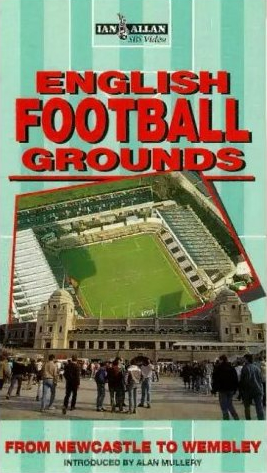
English Football Grounds VHS - Part 1

I have a confession to make... I have an obsession with stadiums. I blame it all on the San Siro and Italia 90. It’s my issue and I’ve come to peace with it. It does, however, mean I have several rather nerdy items in my football collection. The truly awesome Football Grounds of Europe by Simon Inglis, several volumes of Football Grounds from the Air... and this video...


The film opens with a shot of an empty Molineux stand and through the magic of cross fading, the ground slowly fills up, noise level rising as it does. Finally, the players run out on to the pitch to a cacophony of cheers. This then fades to black and some truly awful late 70s synth soundtrack kicks in... welcome to the world of low budget videos people!

The titles then inform us that the video is introduced by the legend that is Alan Mullery.

Never mind the quality, feel the...er...Mullery?

And then he appears. Eloquent, fluid, erudite, mellifluous... these are all words that describe the polar opposite of Mr. Mullery’s presenting style...and I use the word ‘presenting’ in its loosest possible sense. The best way I can describe Alan’s segues is you get the creeping sense that he’s been taken hostage by a terrorist group and with gun to head, is being forced to read out his plea to the Prime Minister, only for someone to have replaced the carefully prepared script at the last minute with some stuff about football league grounds... His eyes darting left to right as he struggles to muster any real enthusiasm for the words he’s supposedly written, there are clear signs of torture... though it’s us who is suffering, toes curling to extremes.

“In the next 70 minutes (oh lord!) or so, we aim to show you the huge changes that have taken place in the last few years...”

Just read that quote again then remember this was filmed in 1994. Now think of the state of most grounds in 2012 and you get the feeling Alan’s brain would have melted...though based on this video, I think it was almost there.

Thankfully, we soon get to the meat of the video and, with the hint dropped that we’re off to the ‘far north’, what feast of the senses are we treated to? Which huge ground do we get sight of to cease our pavlovian salivating?

This...


OK...

“So where are we off to first Dave?” enquires a disembodied female voice.
“Izzup to the norfeast to sint jamezzzzez park”, comes the answer.
Despite the shaky production values and obviously limited budget, it’s at this point that the video really does come into its own.  This is the first glimpse you get of St James’ Park...

I can see it!!!

This is less than 20 years ago, but the place is hardly recognisable.

The quirkiness then continues where the team decide to include the scene where they announce that “the first thing they should do is go to reception and get permission to go into the ground”. There’s detail and there’s DETAIL!

Once ensconced within, the changes that have taken place “in the last few years” are detailed. This was at a time when St James’ Park was halfway through its first major rebuilding phase, with the 2 ends being transformed from terracing to steep banked seating with their deep covered roofs. At this stage, only one of those ends had been completed; the other was still a low, open terrace and there’s still terracing in the main stand. The commentary makes the point that ‘fans familiar with the ground just a few years ago, wouldn’t recognise it today’ and, following a camera sweep around it, it’s hard to see anyone from the present recognising that particular incarnation of the ground.  Also of note, there’s not a single Sports Direct logo anywhere, though there is a Northern rock hoarding.

It’s also interesting to note that Keegan was so popular at the time, he even drew a crowd waiting for a bus...

Gimme Shelter...
We then move onto Middlesbrough, accompanied by some cod Wurlitzer style tunes...lovely! So...what did the Riverside look like in 1994? This...

Not actual size
Of course,  it wasn’t yet built for the ‘Boro still played at Ayresome Park in 1994. With no hint of irony given how soon they were to abandon the place, the narrator tells us that this is a place steeped in history. Hmmm...
History smells funny...
Without warning, Alan pops up again to deliver a stunning anecdote about playing Brian Clough for the first time...and by stunning, I mean deathly. I have a suspicion that Steve Coogan has this video in his collection somewhere. Needles to say, he had the last laugh.

So where are we off to next on this odyssey from Newcastle to Wembley?  Why, York City of course!

After the now obligatory ground pan, we’re treated to some footage of York against Colchester from the 1992/3 season for no apparent reason, other than maybe to show what a game looks like if you film it from behind a support column.

Mmmm... Posty...

One exciting anecdote from Alan later and we’re off to yet another ground that no longer exists... a beautifully snow covered Leeds Road in Huddersfield. While progress is a natural thing in life and most of these grounds were archaic even in the 90s, it is rather saddening to see so much that is now housing developments and supermarkets. Yes the grounds that replaced these decrepit old homes have better seating, views and facilities, but they also look so damn similar! The true joy of this video is the sheer variety of stands and terraces you get, often all within one ground. These places told a story. You could often see the history of a club just by looking from left to right.

At least what was to be known initially as the McAlpine Stadium was a rather unique looking thing in itself and can be seen here mid-construction.

At this point it was known as the McAlp
Here’s Alan again... Shankly, Dennis Law, 6 goals, Frank Worthington, Trevor Cherry all get a mention and I’ll cut him some slack here... he’s clearly speaking from memory rather than a cue card and a genuine sparkle is detectable as he tells us how none of them ever got a result there.

It’s Ewood Park now and here we have yet another ground in the middle of being built. This was of course the time when Jack Walker’s millions were transforming the club and the ground itself. Fast forward 18 years and how things have sadly changed...

Then to Anfield - or not as they clearly weren't allowed in, so instead some footage of them destroying Crystal Palace and some exterior shots of the famous Kop... where it can be seen that in 1994, you could get into a Liverpool game for £8... to repeat, that’s EIGHT POUNDS!

8 Quid???
A shot of the Hillsborough memorial then serves as what feels like a somewhat tasteless link to move on to Sheffield Wednesday’s ground. For a second...then it’s on to the red half of Manchester.

“A vast amphitheatre...now complete”. Complete in the sense of the old terracing having just been converted into seating and the roof line joined up, taking the capacity to a then mammoth 40,000. Only 2 years later, the huge, 3 tier stand took shape and kicked off the next phase of Old Trafford’s redevelopment.

Next up, Sheffield United and Dave “Harry” Bassett, the then manager, gives us quite an accurate description of the state of football ground development at the time, pointing out that since the Taylor report, a lot of grounds higher up the league have improved immensely, while those further down are stuck in less than desirable surroundings. The most interesting thing about his piece to camera, though, is that he doesn’t appear to take a breath all the way through. Honestly, he never once stops talking. A quick pan round the ground, which I have to say, looks like a shed, and up pops Dave again, detailing all the forthcoming changes to Brammal Lane... and again, no pausing. Either he’s nervous or he’s just imbibed a handful of speed.

Breathe Dammit!!!!

It's then off to Chester City's brand new Deva Stadium... and at this point (not even half an hour into the video), I'll pull into the motorway services for a 'comfort break' and see you all again in part 2...