It's the gift that every football-loving child of the early 1970's wanted - a t-shirt featuring the face of Kevin Keegan with a black eye. And yours for only 92p!
But not only that - if you were a regular purchaser of Lion comic back in 1972, you could also buy a t-shirt featuring a footballer that hadn't been involved in a punch-up, such as Rodney Marsh, Peter Osgood or... er... Billy Bremner? Actually, even the shirt featuring Gordon Banks can't have been that good, judging by the expression of the kid in the middle.
This, of course, was the precursor to many a product that now finds itself widely available on the internet (although some are better than others), and can thereby consider itself ahead of its time.
Or indeed, a head of its time. A ha-ha.
(Image reproduced by kind permission of combomphotos)
Showing posts with label 1972. Show all posts
Sunday, May 19, 2013
Saturday, September 1, 2012
The Esso Collection of Football Club Badges, 1972
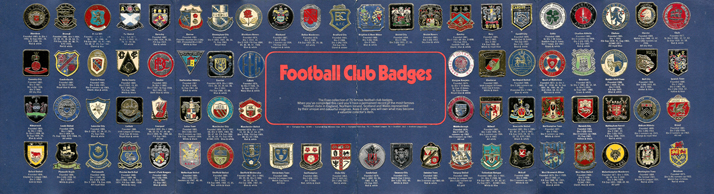
Football club badges somehow seemed to matter more in previous decades. Pick up any book or magazine and they were everywhere, as if it was your duty as a young child to memorise and appreciate the graphic identity of every team. This was never more apparent than in The Esso Collection of Football Club Badges from 1972.
Esso had already achieved incredible success with the now-famous England World Cup Coin Collection of 1970 but were keen to reinforce their position as the favoured petrol supplier for English fans everywhere.
As part of their ongoing connection with the world of football, Esso came up with a scheme whereby drivers could claim a free foil badge featuring any one of 76 clubs from England, Scotland, Wales and Northern Ireland with every four gallons of petrol. There was a special board on which to mount your badges, and if you were in a hurry to complete your collection, there was also a starter pack of 20 badges available, reasonably priced at just 20p.
Once again, Esso had hit upon the winning idea that's at the heart of any football-related collection, namely to lure customers into spending as much money as possible in order to complete a highly desirable set. And desirable it most certainly was. Like the England World Cup Coin Collection, the allure was to be found squarely in the shiny qualities that lay within. In fact you could say that Esso were way ahead of Panini on the shiny badge front and were the first to realise that a humble club insignia could be livened up with the application of a metallic sheen.
Curiously, this collection didn't feature all 92 badges for each of the English Football League clubs. Whether that was because of copyright issues, or whether some clubs just weren't deemed important enough we'll never know, but it was certainly admirable of Esso to include clubs such as Glentoran and Cowdenbeath to add an extra degree of interest.
As you'd expect, many of the badges featured look somewhat different to the way we know them today. Some, such as those for Crystal Palace, QPR, Bolton and Hibernian are barely recognisable, but that's in a good way, not bad. It's incredibly important that such changes in graphical design are remembered for the ages, no matter how basic or quirky they may look, and this Esso collection does that in spades.
For anyone interested in having their own Esso Collection of Football Club Badges, there's good news. Many are still available to buy on eBay for a very inexpensive price and you'd do well to grab one. They're a fabulous addition to anyone's Football Attic.
Esso had already achieved incredible success with the now-famous England World Cup Coin Collection of 1970 but were keen to reinforce their position as the favoured petrol supplier for English fans everywhere.
As part of their ongoing connection with the world of football, Esso came up with a scheme whereby drivers could claim a free foil badge featuring any one of 76 clubs from England, Scotland, Wales and Northern Ireland with every four gallons of petrol. There was a special board on which to mount your badges, and if you were in a hurry to complete your collection, there was also a starter pack of 20 badges available, reasonably priced at just 20p.
Once again, Esso had hit upon the winning idea that's at the heart of any football-related collection, namely to lure customers into spending as much money as possible in order to complete a highly desirable set. And desirable it most certainly was. Like the England World Cup Coin Collection, the allure was to be found squarely in the shiny qualities that lay within. In fact you could say that Esso were way ahead of Panini on the shiny badge front and were the first to realise that a humble club insignia could be livened up with the application of a metallic sheen.
Curiously, this collection didn't feature all 92 badges for each of the English Football League clubs. Whether that was because of copyright issues, or whether some clubs just weren't deemed important enough we'll never know, but it was certainly admirable of Esso to include clubs such as Glentoran and Cowdenbeath to add an extra degree of interest.
As you'd expect, many of the badges featured look somewhat different to the way we know them today. Some, such as those for Crystal Palace, QPR, Bolton and Hibernian are barely recognisable, but that's in a good way, not bad. It's incredibly important that such changes in graphical design are remembered for the ages, no matter how basic or quirky they may look, and this Esso collection does that in spades.
For anyone interested in having their own Esso Collection of Football Club Badges, there's good news. Many are still available to buy on eBay for a very inexpensive price and you'd do well to grab one. They're a fabulous addition to anyone's Football Attic.
See also:
Friday, July 6, 2012
Observer's Book of Association Football, 1972
Around the age of ten, I could often be found at the Thames View Library in Barking, Essex. It wasn’t because I yearned to absorb every ounce of knowledge from the hundreds of books that lay before me; moreover, my sister worked there and I often popped in on my way home from school to say 'hello.'
I’d linger a while, ambling up and down the aisles between the wooden bookshelves that matched me for height. Such were the frequency of my visits that I seemed to recognise many of the books purely by spine alone. Few of the titles were tempting enough for me to pick them up and read them, but the small ‘Sports’ section had an altogether greater appeal as that was where I’d find the football books.
One book always seemed to catch my eye. It was small with a white cover and was clearly born of a bygone age. It was called The Observer’s Book of Association Football and had a picture of Bobby Charlton on the front playing for England in the 1970 World Cup.
Though the book seemed a little antiquated even back in the early 1980’s, it retained an unusual allure. Inside this pocket digest were pages and pages featuring potted profiles of each Football League club including Barrow and Workington, whoever they were.
There were also summarised histories of some of the world’s greatest football clubs and outlines of every great player in the international game back in 1972, the year the book was published.
Yet to be honest, the many informative and enlightening words written by Albert Sewell were not my main interest. Whenever I removed the book from its shelf with all the inevitability of a moth drawn to a light bulb, I would turn instinctively to the small group of colour pages a fifth of the way through. Upon those pages were illustrations of virtually every shirt worn by league clubs in England and Scotland, and I couldn’t be more fascinated in them.
As you can see by the composite picture below, there were countless colours and designs to wonder at, all in long sleeves and none bearing so much as a club badge or a manufacturer’s logo. Some of the shirts looked familiar, like Arsenal’s famous red-white-white-sleeves combo or the Blackpool shirt upon which my school football team’s identity was based. Other designs already looked dated, such as Crystal Palace’s claret and blue vertical bands, but somehow it was of little relevance. These were my formative years in which the recognition of a team’s colours were key to my education and appreciation of a club’s history. All knowledge was good knowledge.
I could go on about the World Cup competition section near the back of the book or the black-and-white photo section in the middle, but there seems little point. This miniature encyclopaedia, the 47th in a series covering topics as diverse as ‘House Plants’ and ‘Freshwater Fishes’ was always my favourite book out of all those in my local library.
Though the building has long since gone, the book remains and I’m reassured to find that even now as a nostalgic 40-year-old, I still find that colour section just as appealing as ever.
I’d linger a while, ambling up and down the aisles between the wooden bookshelves that matched me for height. Such were the frequency of my visits that I seemed to recognise many of the books purely by spine alone. Few of the titles were tempting enough for me to pick them up and read them, but the small ‘Sports’ section had an altogether greater appeal as that was where I’d find the football books.
One book always seemed to catch my eye. It was small with a white cover and was clearly born of a bygone age. It was called The Observer’s Book of Association Football and had a picture of Bobby Charlton on the front playing for England in the 1970 World Cup.
Though the book seemed a little antiquated even back in the early 1980’s, it retained an unusual allure. Inside this pocket digest were pages and pages featuring potted profiles of each Football League club including Barrow and Workington, whoever they were.
There were also summarised histories of some of the world’s greatest football clubs and outlines of every great player in the international game back in 1972, the year the book was published.
Yet to be honest, the many informative and enlightening words written by Albert Sewell were not my main interest. Whenever I removed the book from its shelf with all the inevitability of a moth drawn to a light bulb, I would turn instinctively to the small group of colour pages a fifth of the way through. Upon those pages were illustrations of virtually every shirt worn by league clubs in England and Scotland, and I couldn’t be more fascinated in them.
As you can see by the composite picture below, there were countless colours and designs to wonder at, all in long sleeves and none bearing so much as a club badge or a manufacturer’s logo. Some of the shirts looked familiar, like Arsenal’s famous red-white-white-sleeves combo or the Blackpool shirt upon which my school football team’s identity was based. Other designs already looked dated, such as Crystal Palace’s claret and blue vertical bands, but somehow it was of little relevance. These were my formative years in which the recognition of a team’s colours were key to my education and appreciation of a club’s history. All knowledge was good knowledge.
I could go on about the World Cup competition section near the back of the book or the black-and-white photo section in the middle, but there seems little point. This miniature encyclopaedia, the 47th in a series covering topics as diverse as ‘House Plants’ and ‘Freshwater Fishes’ was always my favourite book out of all those in my local library.
Though the building has long since gone, the book remains and I’m reassured to find that even now as a nostalgic 40-year-old, I still find that colour section just as appealing as ever.
Subscribe to:
Posts (Atom)