Showing posts with label Wembley. Show all posts

Friday, May 3, 2013

FA Cup Final Day - ITV-style (Part 1)

With just seven days to go until the 2013 FA Cup Final, we begin a week-long series of FA Cup-themed articles here on The Football Attic..

If you heard our recent podcast called 'FA Cup Memories', you'll know that many people (ourselves included) still fondly remember the classic Cup Final Day coverage on TV.

As a child growing up in the UK, one tends to recall ITV and BBC starting their build-up to the big event well before lunchtime. Special features would be shown involving the Cup Final players, celebrities and all manner of novelty fare. This was, after all, the biggest game of the domestic season and the two main UK TV channels did all they could to make sure you tuned in to them for Cup Final Day.

While the BBC's coverage was somewhat earnest and straight-laced, ITV allowed itself to have a bit more fun in its presentation of the big event. To that end, let's remind ourselves of how World of Sport did 'FA Cup Final Day' down the years, starting here with Part 1...

1967
Duration: 12.30pm to 4.55pm

Presented by Eamonn Andrews, Dickie Davies (or Richard Davies as he was still known at the time) was just a roving reporter at Wembley along with Peter Lorenzo (father of Matt, ITV's anchorman during the 1994 World Cup).

The era of bold, eye-catching coverage hadn't yet arrived, so if Davies or Lorenzo had managed to grab a quick chat with a celebrity before kick-off, you'd have counted yourself lucky. This was, to all intents and purposes, a fairly ordinary edition of World of Sport, albeit one presented from Wembley.

Among the non-football items were horse racing from Lingfield, wrestling from the Clifton Hall, Rotherham (featuring Jackie Pallo), and the Australian Pools results.

1969
Duration: 12pm to 5.15pm

Richard Davies was now the main presenter of World of Sport while Brian Moore had taken over commentating duties from Hugh Johns. Jimmy Hill and Barry Davies were on hand to interview ITV's pundits including Danny Blanchflower and Billy Wright, while Jimmy Greaves and Bobby Charlton were brought in as special guests.

One or two special features were now forming part of the Cup Final feast on the commercial channel, one of which was 'Wembley In The Sixties' - a chance to show highlights from great games including the 1966 World Cup Final, the 1968 European Cup Final and the 1969 League Cup Final between Arsenal and Swindon Town. Ten minutes were also spared to look at the Football Writers Dinner at London's Café Royal.

Once again, a few footballing palate cleansers were provided in the form of Whitbread Gold Cup horse racing and professional wrestling.

1970
Duration: 12pm to 5.15pm

Not much change on the previous year. Instead of 'Wembley in the Sixties' we had 'Cup Finals of the Sixties', plus there was the usual recap of all the best goals scored earlier in the competition and interviews with players and pundits.

One big gimmick came to light, however, in the form of the ITV Computer. Fred Dinenage provided an early explanation on how the computer (think tape reels and flashing lights) would, by 2.15pm, be churning out a prediction on the FA Cup Final result. Inevitably the prediction, based on the statistical data fed into it, was wrong, but it did give Jimmy Hill and co. plenty of reasons to discuss its accuracy prior to kick-off.

No horse racing this year, but the wrestling was an 'International Special,' for what it's worth.

1971
Duration: 11.30am to 5.15pm

ITV's earliest start yet as Richard Davies partnered up with Jimmy Hill who refereed a pre-Final debate on the Arsenal v Liverpool match with Malcolm Allison, Pat Crerand and Derek Dougan - the classic ITV Sport panel, for many people.

'Wembley Starspot' was a regular feature throughout the day where Davies interviewed personalities in the 'World of Sport Celebrity Bar.' Around lunchtime was 'Penalty Prize' - a five-minute item where "On The Ball's penalty champion, 15-year-old Ken Henderson from Sunderland" tried to outdo "the panel's penalty king, Bob McNab".

Kids also featured in 'My Dad's At Wembley' where the sons of some of the Arsenal and Liverpool players talked to Brian Moore and Keith Macklin about their fathers and favourite players.

Again, horse racing and wrestling were present in the line-up, along with the cursory five-minute check to see how the Scottish FA Cup Final had gone.


1972
Duration: 11.15am to 5.10pm

Very much 'as you were' in '71 with many of the pundits, presenters and features from the previous year retained, but fortunately we could now call Richard Davies 'Dickie' to cast aside all that unnecessary formality.

Fortunately a couple of new items were brought in to freshen up the schedule. 'Cup Final Comedians' appeared at 1.25pm with 15 minutes of football fun and gags from the likes of Mike Reid, Frank Carson, Bernard Manning and Charlie Williams. With half an hour to go before kick-off, 'The Football Association Pageant' was a 20-minute parade inside Wembley to celebrate the FA's centenary, commentated on by Brian Moore.

'International Athletics' was also added to the non-football content.


1973
Duration: 10.30am to 5.10pm

ITV really pushed the boat out with a super-early start in 1973. Replacing 'The Comedians' this year was a special edition of 'Who Do You Do?' - a popular show featuring impersonators of the day including Eddie Large and Janet Brown. A five-minute segment called 'My Man's At Wembley' also appeared at 1.15pm where the British public got to 'meet' the players' wives.

Another brief change of pace came along in the shape of 'Cup Final Athletics' - "special pre-match invitation races held at Wembley Stadium." Exactly why we're not entirely sure. More interesting, perhaps, was the ITV 'Sky-High' camera providing "a sensational plan-view of the stadium."

1974
Duration: 11am to 5.10pm

Back to an 11 o'clock start this time, shortly after which was 'Football Crazy!'  Here, Ed 'Stewpot' Stewart combined football songs and goal action with children from Liverpool and Newcastle, the 1974 finalists. "Two pop-stars who love their football" were also on hand along with some kids "with well-known sporting dads."

This was the year when 'Camera on the Coach' arrived to give us a unique insight into how 20 angst-ridden men travelled five miles to Wembley in near silence but for the encouraging words of a roving reporter and his microphone. And if the satellite link remained intact for more than five minutes at a time, so much the better, but there was no guarantee of this.

'Talk of the Stars' gave a knowing nod back to the days of the ITV computer by enlisting TV Times astrologer Roger Elliot to predict the outcome of the 1974 FA Cup Final. Five minutes later, 'Footballer's Fancies' invited some of the players to give their tips for the winner of the 2,000 Guineas which was shown immediately afterwards as part of ITV's Cup Final coverage.

A reminder for anyone that might have forgotten: this was 1974 - not 2013.


1975
Duration: 11am to 5.10pm

Quite honestly there wasn't much innovation in ITV's 1975 Cup Final schedule, except for the inclusion of some... how shall we say... 'dubious' personalities?

Aside from the wrestling, the horse racing, the highlights package from previous rounds of the Cup and the Australian Pools results, the only 'highlights' of note were 'Freddie Starr!' at 12pm, 'Freddie Starr Again!' at 1pm and 'Football Crazy' which followed the same format as in 1974 but this time featured various guests including Gary Glitter.

We'll be moving not-so-swiftly onto Part 2 of our ITV Cup Final Day guide very soon, and in it we'll take in juvenile commentators, Dutch astrologers and hopefully no-one questioned as part of Operation Yewtree.

Friday, March 15, 2013

England v Spain programme, 1968

You can tell how old this match-day programme is because on page 2 there’s an explanation of what the European Championships is all about and how it came to be formed. Your average English football fan actually had to be told what the competition was all about.

This somewhat thin pamphlet commemorating the occasion of England’s quarter-final against Spain in April 1968 may not contain much, but it gently informs and educates the reader about a tournament that was still only eight years old at the time. Of the two previous occasions when it was held, England hadn't taken part in the first and had been eliminated in the Preliminary Round during the second.


Things were different now, however. England were world champions and had qualified for the quarter finals of the 1968 European Championships by finishing top of a group featuring Scotland, Wales and Northern Ireland. Spain, the visitors to Wembley for the first leg of this knockout tie, were European champions but had struggled to edge past a decent Czechoslovakia side in their group.

The Spanish side were making their second visit to Wembley in less than a year, as shown on page 4. A friendly match in May 1967 had resulted in a 2-0 win for the home side but “victory did not come easily, nor soon.” England fans had waited until the 72nd minute for Jimmy Greaves to break the deadlock while Roger Hunt added a second six minutes later.

Sunday Mirror journalist Sam Leitch made light of the fact that there was an abundance of goalkeeping talent at England’s disposal. As well as the legendary Gordon Banks, Sir Alf Ramsey could also call upon the talents of Chelsea’s Peter Bonetti and Manchester United’s Alex Stepney.

For those who think Chelsea’s free-spending habits are a recent development, Leitch provides food for thought: “How remarkable that both Bonetti and Stepney began last season with the same club - Chelsea! Despite having the security of Bonetti. Chelsea went out and paid a new record fee for a goalkeeper of £55,000 to Millwall for Stepney. Then put him in the reserves.”

The top talent between the sticks didn’t end there. Peter Springett (Sheffield Wednesday), Peter Grummitt (Nottingham Forest) and Peter Shilton (Leicester City) were all pushing for attention as well as someone who Sam Leitch came desperately close to tipping for future greatness: “Then there is a young man called Dave Clemence who appeared for England’s Under-23 team against the Welsh Under-23 earlier this season. Clemence is the Liverpool reserve keeper!” I wonder whatever happened to Liverpool’s ‘Dave’ Clemence...?

Jack Rollin, statistician par excellence, was on hand to give a profile of Spain’s recent success in the European Championships as well as England’s previous matches against them. Fortunately for the English, Spain had only won three of the last nine encounters, although one had contributed to England’s disastrous campaign in the finals of the 1950 World Cup.


With fortune on their side, then, Ramsey’s team could stride confidently out onto the Wembley turf knowing that only an earlier rendition of ‘Oklahoma’ by the Band of the Irish Guards could possibly outshine them.

By the end of the night, the home fans would witness a 1-0 win for England thanks to a late Bobby Charlton goal, and if they’d forked out the £21 fare for a two-day trip to Madrid the following month, they’d have also seen the 2-1 win that ultimately earned Sir Alf’s men a place in the Euro ‘68 semi-finals.


Tuesday, October 16, 2012

The Scoreboard: A display of practicality

I’m embarrassed to say it, but I used to have a bit of a thing about scoreboards when I was younger. Stadium scoreboards, game show scoreboards, cricket scoreboards… you name it, I loved it.

There was something about those static signs  with changeable numbers that had me transfixed as a kid. If someone scored a point in a football match or on a TV quiz show, I’d wait with eager anticipation to see the scoreboard update the total, be it manually or digitally. It’s ridiculous, I know, but I loved the magisterial sense of purpose that a scoreboard possessed.

This blog doesn’t take TV nostalgia as its subject, else you’d be spending the next 15 minutes reading about It’s a Knockout or Family Fortunes. Instead I shall turn my attention towards the humble football scoreboard, and they don’t come much humbler than the one installed at Wembley Stadium around the time of the 1966 World Cup.

Essentially this was a single-line display showing the two competing teams and the score. Being very much old-tech, the scoreboard was literally just a printed  or painted sign with white characters on a black background along with those all important changeable numbers. And those numbers needed some effort to change as the full set were available as individual tiles that had to be lugged around and slotted into place by a couple of men in white coats whenever anyone scored. It was simple, but it worked.

After a while, Wembley put in place an electronic scoreboard which, compared to its predecessor must have seemed like it had arrived from another planet. Using a vast array of light bulbs switched on and off in distinct configurations, rudimentary characters could shine out from the inky black background to tell the crowd what the score was and also who had scored. Such electrical wizardry can't have been lost on a generation eager to see technological advancements improving their game-viewing experience.

Around the UK, scoreboards of all kinds had appeared at football grounds right from the very early days but they never really had the 'wow' factor, nor did they become a universal feature. Scoreboards (old-fashioned or new) were high-maintenance and often expensive so only the most committed clubs went out of their way to get one.

Sheffield Wednesday’s Hillsborough ground got an electronic one around the time of the 1966 World Cup, but like so many of their day, it had its faults. Blown bulbs and faulty mechanisms meant text was displayed with letters missing or even shown on a different area of the scoreboard. After a while, fans got used to the garbled messages and even grew to like them as a distraction from the action taking place on the pitch.

Fully digital scoreboards like Wednesday's were slow to make an impact and venues hesitantly looked for a compromise. Despite the 1970's beginning on the crest of a scientific NASA wave, the greatest tournament on the planet was still relying on name cards and a handful of bulbs to tell people what they needed to know. If it wasn't for the opportunity to raise some money from the advertising space it provided, many scoreboards probably wouldn't have even seen the light of day.

In the end, our first sight of a new-age scoreboard didn't arrive in England or South America, but from the one place most people least expected it. Over in the United States, the occasional blown bulb wasn't going to stop NASL clubs making a song and dance about the new-found sport they were purveying.

With players like Franz Beckenbauer, George Best and Pele in town, fans needed to be reminded about the razzmatazz they were witnessing, or at least reminded who it was they were watching.

In addition to the basic electronic scoreboards already resident at some NFL and baseball stadia, bigger, more advanced displays cropped up at a small selection clubs across the country. Many of them not only displayed the score and scorers but also entertained the fans with animated imagery and messages.

With such extravagance creeping into the world game, it was hardly surprising that Subbuteo updated their own scoreboard accessory to a more modern version in 1978. The World Cup that year reinforced the notion (at Buenos Aires at least) that a new technological age had dawned, yet actually the rate of progress was still painfully slow. Even in Spain four years later, the old hand-painted name plates and tiles were still being used.

It would ultimately be up to the major stadia of the world to lead the way where modern scoreboards were concerned. At seemingly every major Cup Final on every continent of the world, scores and scorers were illuminated for ticket-paying supporters with great efficiency and clarity. Huge matrices arrived to give displays better clarity and definition, to say nothing of bigger text. Yet just as soon as they'd reached the peak they were always destined for, traditional scoreboards were starting to see the writing on the wall. (Or should that be 'board'?)

By the mid-1990's, Sony's Jumbrotron system was appearing at some of the world's major musical and sporting events, affording spectators the chance to see real-time video on enormous screens. The ability to provide people not just with text-based information but moving pictures and action replays left the traditional scoreboard looking rather old-fashioned and redundant all of a sudden. Even down-at-heel football clubs across the UK saw the potential to attract fans, even if it meant snapping up cruder, cheaper versions of Sony's big screen.

And so we find ourselves in 2012, an age where virtually every Premier League ground seems to have a big video screen tucked away in at least one corner of the ground. For all that, however, some clubs have remained true to the old virtues, believing that a simple scoreboard should not be a big distraction to the things happening on the pitch. Therein lies hope for the future - a reminder that sometimes we can learn a lot from the things we learned in the past. Video screens are all well and good, but the scoreboards of days gone by told us exactly what we needed to know in a beautifully simple way.

Saturday, June 9, 2012

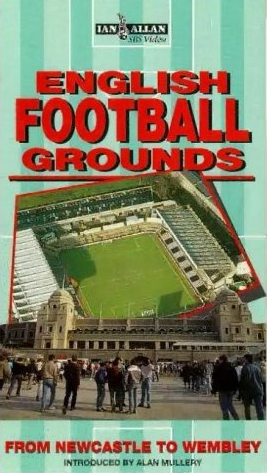
English Football Grounds VHS - Part 1

I have a confession to make... I have an obsession with stadiums. I blame it all on the San Siro and Italia 90. It’s my issue and I’ve come to peace with it. It does, however, mean I have several rather nerdy items in my football collection. The truly awesome Football Grounds of Europe by Simon Inglis, several volumes of Football Grounds from the Air... and this video...


The film opens with a shot of an empty Molineux stand and through the magic of cross fading, the ground slowly fills up, noise level rising as it does. Finally, the players run out on to the pitch to a cacophony of cheers. This then fades to black and some truly awful late 70s synth soundtrack kicks in... welcome to the world of low budget videos people!

The titles then inform us that the video is introduced by the legend that is Alan Mullery.

Never mind the quality, feel the...er...Mullery?

And then he appears. Eloquent, fluid, erudite, mellifluous... these are all words that describe the polar opposite of Mr. Mullery’s presenting style...and I use the word ‘presenting’ in its loosest possible sense. The best way I can describe Alan’s segues is you get the creeping sense that he’s been taken hostage by a terrorist group and with gun to head, is being forced to read out his plea to the Prime Minister, only for someone to have replaced the carefully prepared script at the last minute with some stuff about football league grounds... His eyes darting left to right as he struggles to muster any real enthusiasm for the words he’s supposedly written, there are clear signs of torture... though it’s us who is suffering, toes curling to extremes.

“In the next 70 minutes (oh lord!) or so, we aim to show you the huge changes that have taken place in the last few years...”

Just read that quote again then remember this was filmed in 1994. Now think of the state of most grounds in 2012 and you get the feeling Alan’s brain would have melted...though based on this video, I think it was almost there.

Thankfully, we soon get to the meat of the video and, with the hint dropped that we’re off to the ‘far north’, what feast of the senses are we treated to? Which huge ground do we get sight of to cease our pavlovian salivating?

This...


OK...

“So where are we off to first Dave?” enquires a disembodied female voice.
“Izzup to the norfeast to sint jamezzzzez park”, comes the answer.
Despite the shaky production values and obviously limited budget, it’s at this point that the video really does come into its own.  This is the first glimpse you get of St James’ Park...

I can see it!!!

This is less than 20 years ago, but the place is hardly recognisable.

The quirkiness then continues where the team decide to include the scene where they announce that “the first thing they should do is go to reception and get permission to go into the ground”. There’s detail and there’s DETAIL!

Once ensconced within, the changes that have taken place “in the last few years” are detailed. This was at a time when St James’ Park was halfway through its first major rebuilding phase, with the 2 ends being transformed from terracing to steep banked seating with their deep covered roofs. At this stage, only one of those ends had been completed; the other was still a low, open terrace and there’s still terracing in the main stand. The commentary makes the point that ‘fans familiar with the ground just a few years ago, wouldn’t recognise it today’ and, following a camera sweep around it, it’s hard to see anyone from the present recognising that particular incarnation of the ground.  Also of note, there’s not a single Sports Direct logo anywhere, though there is a Northern rock hoarding.

It’s also interesting to note that Keegan was so popular at the time, he even drew a crowd waiting for a bus...

Gimme Shelter...
We then move onto Middlesbrough, accompanied by some cod Wurlitzer style tunes...lovely! So...what did the Riverside look like in 1994? This...

Not actual size
Of course,  it wasn’t yet built for the ‘Boro still played at Ayresome Park in 1994. With no hint of irony given how soon they were to abandon the place, the narrator tells us that this is a place steeped in history. Hmmm...
History smells funny...
Without warning, Alan pops up again to deliver a stunning anecdote about playing Brian Clough for the first time...and by stunning, I mean deathly. I have a suspicion that Steve Coogan has this video in his collection somewhere. Needles to say, he had the last laugh.

So where are we off to next on this odyssey from Newcastle to Wembley?  Why, York City of course!

After the now obligatory ground pan, we’re treated to some footage of York against Colchester from the 1992/3 season for no apparent reason, other than maybe to show what a game looks like if you film it from behind a support column.

Mmmm... Posty...

One exciting anecdote from Alan later and we’re off to yet another ground that no longer exists... a beautifully snow covered Leeds Road in Huddersfield. While progress is a natural thing in life and most of these grounds were archaic even in the 90s, it is rather saddening to see so much that is now housing developments and supermarkets. Yes the grounds that replaced these decrepit old homes have better seating, views and facilities, but they also look so damn similar! The true joy of this video is the sheer variety of stands and terraces you get, often all within one ground. These places told a story. You could often see the history of a club just by looking from left to right.

At least what was to be known initially as the McAlpine Stadium was a rather unique looking thing in itself and can be seen here mid-construction.

At this point it was known as the McAlp
Here’s Alan again... Shankly, Dennis Law, 6 goals, Frank Worthington, Trevor Cherry all get a mention and I’ll cut him some slack here... he’s clearly speaking from memory rather than a cue card and a genuine sparkle is detectable as he tells us how none of them ever got a result there.

It’s Ewood Park now and here we have yet another ground in the middle of being built. This was of course the time when Jack Walker’s millions were transforming the club and the ground itself. Fast forward 18 years and how things have sadly changed...

Then to Anfield - or not as they clearly weren't allowed in, so instead some footage of them destroying Crystal Palace and some exterior shots of the famous Kop... where it can be seen that in 1994, you could get into a Liverpool game for £8... to repeat, that’s EIGHT POUNDS!

8 Quid???
A shot of the Hillsborough memorial then serves as what feels like a somewhat tasteless link to move on to Sheffield Wednesday’s ground. For a second...then it’s on to the red half of Manchester.

“A vast amphitheatre...now complete”. Complete in the sense of the old terracing having just been converted into seating and the roof line joined up, taking the capacity to a then mammoth 40,000. Only 2 years later, the huge, 3 tier stand took shape and kicked off the next phase of Old Trafford’s redevelopment.

Next up, Sheffield United and Dave “Harry” Bassett, the then manager, gives us quite an accurate description of the state of football ground development at the time, pointing out that since the Taylor report, a lot of grounds higher up the league have improved immensely, while those further down are stuck in less than desirable surroundings. The most interesting thing about his piece to camera, though, is that he doesn’t appear to take a breath all the way through. Honestly, he never once stops talking. A quick pan round the ground, which I have to say, looks like a shed, and up pops Dave again, detailing all the forthcoming changes to Brammal Lane... and again, no pausing. Either he’s nervous or he’s just imbibed a handful of speed.

Breathe Dammit!!!!

It's then off to Chester City's brand new Deva Stadium... and at this point (not even half an hour into the video), I'll pull into the motorway services for a 'comfort break' and see you all again in part 2...

Sunday, February 5, 2012

England v USSR (Match-Day Programme, 1984)

We're delighted to bring you our very first guest post courtesy of Rob Langham, a member of the team behind the brilliant blogsite The Two Unfortunates. Here, Rob takes us back 28 years to an international game he attended at Wembley and the match-day programme that accompanied it...

The programme for England’s international against the USSR, a match that took place on 2 June 1984, is a fascinating time capsule, not least due to the advertising strategies of the time - more of which later.

Unbeknownst to all of us at the time, the Soviet Union only had another seven years to run. Mikhail Gorbachev was still a year away from assuming office and our relationship with the USSR was filtered through the prism of the late Cold War period - tit for tat Olympic boycotts and Frankie Goes to Hollywood’s video for Two Tribes perhaps the most memorable manifestations of international relations.

That was a polyglot Soviet side. Having performed solidly at the 1982 World Cup in Spain, they, like England, had failed to reach that Summer’s European Championships in France. Far from Russian-dominated, the various republics of the union were well represented with captain Aleksandr Chivadze and Tengiz Sulakvelidze representing Georgia, Sergei Aleinikov and Sergei Stukachov hailing from Belarus and Kazakhstan respectively, and the Armenian Khoren Oganesyan acting as the XI’s primary creative force.

All of that was to be swept away two years later of course - as incoming manager Valeriy Lobanovskiy made a better fist of what Ron Greenwood had tried to do with Liverpool players for England the previous decade by jettisoning much of the existing squad (including Oganesyan - dropped for developing a ‘star complex’) and packing the team with the Ukrainians of Dynamo Kyiv.

But for now, it was an effective and unspectacular unit that cantered to a 2-0 victory against an England led by Bobby Robson.

In his programme notes, Robson opined about the lack of availability of players on a consistent basis and it was a weakened team that eventually took the field here - Mike Duxbury’s horrendous error allowing for the first goal and provoking a chorus of boos in a sparsely populated Wembley.

The old guard - Peter Shilton, Terry Butcher, Bryan Robson, Ray Wilkins and Trevor Francis was supplemented by a number of newcomers with perhaps the most significant being Gary Lineker - appearing in the squad for the first time in the 1-0 defeat to Wales that Spring.

But the number of unlikely names betrays a team in transition after the failure to overcome Denmark in European Championship qualifying. Former NASL man Steve Hunt, David Armstrong, Mike Hazard and John Gregory all made it to Bisham Abbey.

The most intriguing of the inclusions was winger Mark Chamberlain, Dad of Alex Oxlade-Chamberlain and a man who performed spiritedly on the afternoon - overshadowing the man on the opposite flank, John Barnes (the latter was to have the last laugh a few days later when he scored after a mazy run against Brazil).


There was also a Watford inflection to things - as reigning European under-21 Champions, Robson had seen fit to promote a number of that set up to the full team and Nigel Callaghan was one to benefit. Add to that Luther Blissett, at the time a Milan player but forged at Vicarage Road nonetheless.

But the theme didn’t end there. In a year that saw the Hertfordshire club reach an FA Cup Final, the programme advertised ‘The Summer of 84 Concert’ for later that month, with chairman Elton John headlining, supported by Nik Kershaw, Paul Young, Kool & The Gang and Wang Chung plus DJ appearances from Steve Wright and Simon Bates among others. Dull and dreary England’s 2-0 defeat may have been but presumably considerably less horrific than the entertainment offered by that shower.

Elsewhere in the publicity sections, the prospect of gridiron action involving the Tampa Bay Bandits and Philadelphia Stars was offered (no, I haven’t heard of them either) and a typically oblique Benson and Hedges adorned the back page - MIDDLE TAR.

Our thanks go to Rob for that wonderful trip down memory lane, and don't forget you can catch more of Rob's writing (together with that of many other fine folk) at www.thetwounfortunates.com. We also urge you to follow TheTwoUnfortunates on Twitter, too.

If you'd like to contribute an article of your own, please do so - simply contact @COakleyFtbl or @sofa_soccer on Twitter or leave us a comment on one of our blog posts and let us know all the details. Cheers!

Thursday, January 26, 2012

Soccerboss / Goal! / Wembley ad, 1969


We wonder what the 'scientific approach' was that was used in 'Goal'? Anyone got any thoughts?